RCx report layout
camber report CONFIG --layout rcx writes the printable retro-commissioning report: one HTML
document a commissioning engineer can hand over, print to PDF from any browser, and annotate.
It is a layout over the existing analytics — the rules, the evidence engine, the cost estimators
and the action recommendations — and adds no new detector or cost model. The module is
camber.report.rcx (provisional, see API-STABILITY.md); the unrelated
camber.rcx holds the functional-test / before-after MBCx primitives.
camber report site.json --out rcx.html --layout rcx
camber report site.json --out rcx.html --layout rcx --week oat-range --paper a4
camber report site.json --out rcx.html --layout rcx --notes notes.json --notes-template slots.json
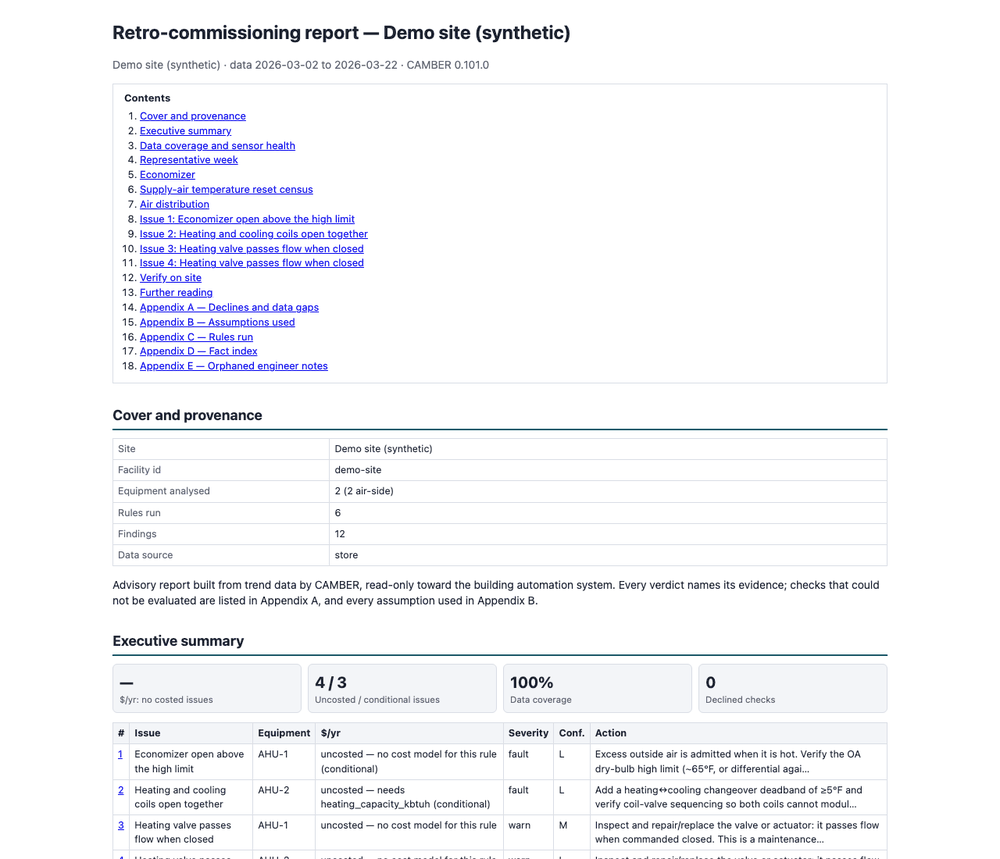
Synthetic data: the opening of an RCx report for a two-AHU demo site: the contents, the cover and the executive summary's KPI strip and issue table.
--layout defaults to the config's report.layout, and that defaults to audit (the
Std-211 audit report), so existing configs behave exactly as before. Any other name is looked up in
the camber.reports plugin entry-point group.
Pages
Every section starts a new printed page; figures and table rows never split across pages, table headers repeat, and the screen-only table of contents is hidden in print.
| Page | Section | What it holds |
|---|---|---|
| P0 | Cover and provenance | The dataset's source, licence and citation first in the body. Research-only (NC/ND) data gets the non-commercial banner, repeated at the top of every printed page. |
| P1 | Executive summary | One page: a KPI strip — costed, non-conditional $/yr; uncosted / conditional issue counts; data coverage; declined checks — and the top-N (default 8) issue table with each issue's $/yr (or uncosted — needs X), severity, confidence and a one-line action, linked to its page. |
| P2 | Data coverage and sensor health | The readiness ribbon; the BAS OAT against a reference (when one is configured); a trust table scored gated (fan-on samples) and ungated, naming the gate used (fan status, fan speed proxy, airflow proxy, or ungated — no fan signal); mixing consistency. |
| P3 | Representative week | The week selected below, as stacked panels, one unit family each (°F / % / in.w.c.). Values are never normalized. Violation shading covers occupied, fan-on time only. Up to four air handlers are charted, then up to two water-side plants (chilled-, condenser- and hot-water plants) on their own panels (PLANT_FAMILIES): water temperatures, loop differential pressure (in the site's own units), electric power and status. A plant has no fan, so its shading covers occupied time. |
| P4 | Economizer | OA fraction vs OAT (temperature balance when MAT/RAT/OAT exist, else damper vs OAT) drawn with the rule's own high limit, minimum OA and differential changeover, next to its verdict. Also MAT-between-OAT-and-RAT and a free-cooling table. When an OAT sensor issue exists, a banner says the verdicts are conditional on OAT. |
| P5 | SAT reset census | Three labelled tiers, below. |
| P6 | Air distribution | Duct static by hour of day (fan-on samples only) and any static-reset findings. Omitted when there is no duct static. |
| P7 | M&V and drift | The drift report and the mv_baseline results, including declines. Omitted when neither ran. |
| P8+ | One page per issue | Headed by the finding's cause (0.98, #88: "Outdoor-air damper not modulating (stuck low)"), not the remedy; the recommended action keeps its own title ("Recommended action — Repair the outdoor-air damper or actuator: ..."), and the executive summary's Issue column shows the cause. When a member finding names the equipment at fault and the root does not, the member's cause heads the issue (0.100, #101; precedence below). $/yr with its basis and assumptions; the evidence charts; the members (root first) with the union violation hours; the recommended action; the confidence grade with "why we believe this"; conditional / dependent notes; the engineer's note. |
| — | Verify on site | 0.98 (#88): the walk-down checklist, after the issue pages (camber.walkdown, provisional). A lead paragraph links PNNL Re-tuning chapter 9 (Building Walk Down), then one table per kind of item, in walk-down order: sensors and setpoints (each sensor a conditional issue leans on, with its trust; a sensor_drift issue's sensor; each input a check declined as untrusted), equipment and controls (one item per issue from a per-rule, per-cause template), design values the checks assumed (a site fact such as a minimum outdoor-air fraction, a high limit or an occupancy schedule left at the rule's default) and points the checks lacked (Appendix A's checks not evaluated). Columns: # (linked to the issue; A for Appendix A), Equipment, Look at, Point, Confirms, Refutes. Section id verify, engineer-note slot section:verify; on by default, omitted when it would be empty. |
| — | Further reading | 0.96 (#78): the PNNL Re-tuning guides and chapters relevant to this report's issues only, guides first, as links (nothing reproduced), plus chapter 9 when the report has a Verify on site section. Each issue page also ends its recommended action with Learn more links, and to_dict() carries each issue's references ids. Section id reading; no engineer-note slot. |
| A–E | Appendices | A: every decline, caveat, trust-gated decline, missing optional input and unevaluated equipment. B: the assumptions actually used — cost defaults, price, sizing, occupancy source, fan-gate source, week-selection scores. C: rules run and a config hash. D: fact index (reserved). E: orphaned engineer notes. |
Issues: grouping, dollars and hours
The report ranks issues, not findings. camber.rules.triage.link_findings groups the findings
on one equipment that share a causal chain (CAUSE_CHAINS: the SAT chain from reset to overcooling
to reheat to simultaneous heating and cooling; the economizer chain; the heating-plant lockout
chain, boiler then hot-water pump (0.103); the static-pressure chain),
with the most upstream finding as the root. An issue's key is the root finding's fingerprint, so it
stays the same from run to run.
- Hours are a union, never a sum. An issue's violation hours are the union of its members' violation masks, gated to fan-on. The "% runtime" figure divides by fan-on hours and says so. Only masks a rule derives itself count. When no member has one, the page reads "not measured" rather than guessing.
- A chain's cost is its largest member, never the sum. The members' estimates price the same wasted energy several ways, so the page shows the largest and notes that the estimates overlap. Different issues add up.
- Uncosted is explicit. An issue with no costed member shows what the estimator needs
(
uncosted — needs heating_capacity_kbtuh). Sizing comes fromreport.loads. - Rank: severity tier; then non-conditional before conditional; then costed before uncosted; then $/yr, largest first. Uncosted issues of one tier then rank by confidence, H before M before L (0.102, #112), so the issue with the most trustworthy evidence leads when no dollars separate them. Ties break on the key, so the order is deterministic.
Sensor precedence. A sensor problem is derived from the data. It is one of three things: a
sensor_drift:<role> finding at warn or fault; an untrusted or stuck trust verdict on the gated
samples; or a mixing-consistency violation. Any finding whose rule reads that role
(roles_required or roles_optional) on the same equipment becomes conditional. For a shared
role like OAT, that covers every equipment that uses it. A conditional issue is annotated and
demoted, never deleted. Its dollars move to "at risk pending sensor fix", and it is listed as a
dependent on the sensor issue's page.
SAT compliance and G36. Some supply_air_reset_compliance findings are judged against the G36
default map because no site sequence is known. Those findings are shown as a reference only. They
are left out of the dollar totals, and their confidence is L. A declared sequence re-judges them
against the site's own map.
Air side and plant links (0.91). The air-side pages (economizer, SAT reset census, air
distribution) cover air handlers only: a VAV box's discharge air, a heat pump's or a fan coil's is
not an AHU's (camber.model.equipclass; an unrecognised class keeps the roles test). When a
chilled-water plant is short of setpoint (chw_supply_tracking) in the same hours an air
handler's supply air runs warm (supply_air_control, G36 FC13), the AHU issue carries the plant
as an upstream cause (Issue.upstream_causes): its page opens with an "Upstream cause: plant
short of setpoint" banner, its recommended action (on the page and in the summary) starts with the
plant, and a "why" line says to check plant capacity before the coil valve. The G36 link reads the
g36_afdd finding's flagged_fcs for FC13 (supply air too warm with the cooling valve full open);
FC12 and FC1 are not plant-capacity symptoms. Since 0.92 the same-hours
test for a G36 finding uses FC13's own hours (the rule's evidence carries one mask per fault
condition, Evidence.masks), not the union of every fault condition it reported, so duct-static or
economizer hours no longer count as plant symptoms; UpstreamCause.unit_hours records "FC13" (or
"finding" when only the whole mask was available). The plant issue lists the findings it may explain
(Issue.downstream). A config topology (TOPOLOGY.md) decides which plant
serves which unit; without one the site's plant is assumed and the line says so.
G36 advice needs a declared G36 sequence. A recommended action that prescribes a Guideline 36
sequence is given as the fix only when the config declares one for the unit: a soo entry with a
g36_* library for its class (a terminal unit counts when its air handler's class, AHU, has one).
Otherwise a check that assumes a G36 sequence (a rule named *_g36 or g36_*) gets no packaged
action ("engineer to specify"), and any other action worded as G36 practice is labelled a G36
reference, to be checked against the unit's own sequence first.
Which cause heads an issue
0.100 (#101). An issue's heading is a cause, read from one finding's recommendation. Some causes
are equipment-level: they name a component that does not do what it is told. These are a
damper that does not deliver the outside air it is commanded to (free_cooling_missed with
missed_cause damper_not_delivering), a reheat valve whose position does not follow its demand
(reheat_penalty at or above the valve-divergence share), a leaking valve (leaking_valve), a
stuck actuator (actuator_stuck) and a drifting OA damper (economizer_damper_drift). The cause is
read as the walk-down reads it (camber.walkdown.cause_key). Other causes name a symptom or a
sequence problem: outside air below the minimum, excess outside air, a reset that does not reach
its end. The heading follows this precedence:
- A root whose own cause is equipment-level keeps the heading.
- Otherwise, the first member in the chain's root-first order (the most upstream) whose cause is equipment-level, and whose recommendation names it, heads the issue.
- Otherwise the root's cause heads it, as before.
The action, its title, its suggested value and its Learn-more links stay the root's in every case.
When a member's cause leads, the page says so in one line above the recommended action ("Cause
from the free_cooling_missed member, which names the equipment at fault (the root finding reads:
...)"). to_dict() issues carry the heading's cause and, from 0.100, cause_rule: the rule of the
finding that names it. The executive summary uses the same heading. For example, an air handler
whose outside air is below its minimum (outdoor_air_fraction, the root) while its damper is
commanded open in mild weather and delivers 5 % outside air (the free_cooling_missed member) is
headed "Outdoor-air damper not modulating (stuck low)", and its action stays "Restore minimum
outside air". On the catalog run templates two issues are re-headed this way. Since 0.100 the
lbnl-ddahu and lbnl-sdahu templates run free_cooling_missed. lbnl-ddahu DMPRStuck_OA_0
now reads "Outdoor-air damper not modulating (stuck low)". lbnl-sdahu damper_stuck_075 reads
"Outdoor-air damper not modulating (stuck part open)", where its root, economizer_high_limit,
reads "Economizer open above the high limit". Since 0.101 (#108) the walk-down's equipment item
follows the same cause (see Verify on site).
Verify on site
camber.walkdown.site_checks (provisional, 0.98) builds the checklist from what the report
already knows; it adds no detector. Each item says what to look at on site, which point to
compare, and what result would confirm the finding (or the flagged problem) and what would
refute it. Every item links PNNL Re-tuning chapter 9 (WALKDOWN_REFERENCES); nothing from the
chapter is reproduced, and the item texts are CAMBER's own.
- Sensors. A conditional issue's sensor causes (
Issue.conditional_on), one item per role, with the gated trust score; a setpoint role asks for the value at the controller and the trend mapping, a sensor role for a reference instrument and the mapping. Sensors come first: a wrong sensor can make any finding that uses it wrong. - Equipment.
SITE_CHECKS[rule][cause], with the cause read from the finding's metrics the way the recommender reads them (CAUSE_KEYS):free_cooling_missed'smissed_cause(a damper that does not deliver is a blades-and-linkage check, an economizer that is never commanded a controller check),chw_plant_reset's reset direction and flow mode, a pump pinned at a VFD floor CAMBER inferred (near_min_source), the reheat valve whose position diverges from its demand, and so on. A rule without a template gets a generic item built from its required inputs. The item follows the cause that heads the issue (0.101, #108): when a member's cause heads it (Which cause heads an issue), the report passes that rule and cause key tosite_checks(heading_causes={issue key: (rule, cause key)}), and the item is the member's template, with that rule's references; otherwise it is the root's. On the 15 catalog run templates this changes 2 of 98 issues' items, the two re-headed ones:lbnl-ddahuDMPRStuck_OA_0(from the minimum-outdoor-air damper position to the outdoor-air damper's blades, linkage and actuator) andlbnl-sdahudamper_stuck_075(from the damper on a hot hour against the high limit to the same blades-and-linkage check). - Design values.
DESIGN_PARAMSnames the site facts a rule assumes (not its detection thresholds). An item is listed when the issue's rule ran with that parameter at its default (not named in the config'srules[].params): confirm it against the drawings or the controller, and set it in the config if it differs. - Data.
RunResult.rules_skipped(missing_inputs,no_data), grouped like Appendix A: is the point on the controller but not trended or mapped, or does the equipment not have it?
Duplicates (same kind, equipment and point) are listed once, under the first issue that needs them.
Confidence
Each issue gets H, M or L: the minimum over the components below. Each component writes one "why we believe this" line.
| Component | H | M | L |
|---|---|---|---|
| Input trust (gated) | every input trusted |
one suspect |
one untrusted, or the issue is conditional |
| Mapping | roles recorded at ingest (store source) | a config tag-to-role mapping | a point looks like a percent signal mapped to a flow role |
| Assumptions | the rule's parameters come from the site config | rule defaults | a reference the site never declared (G36 default with no sequence) |
| Sample / coverage | at least 168 samples judged and full input coverage | at least 48 samples, or coverage below 80 % | fewer samples, or coverage below 50 % |
| Corroboration | the rule scores TPR ≥ 0.9 and FPR ≤ 0.05 on the synthetic benchmark | scored, but lower | — |
A component that cannot be assessed is left out of the minimum, and its line says so.
Choosing the representative week
select_week is deterministic, and its explanation is built only from the numbers it reports.
- The candidates are the Monday-00:00 7-day windows, in the data's local clock.
- A window is eligible when the charted roles cover at least 80 % of its gated (fan-on)
samples and it has at least 3 occupied days. The week is scored on the air handlers' air-side
roles (
P3_FAMILIES). A report with no air handler (a chiller or boiler plant on its own) is scored on its plants' roles (PLANT_FAMILIES) instead, ungated when a plant has no fan signal; on a mixed site the plants are charted in the air handlers' week. When no window is eligible, the report declines to chart a week and says why. - Each window is scored by the chosen mode, plus
0.1 × coverage: evidence(default, andauto): the sum over issues of(1/rank) × (gated violation hours in the window / the issue's total). Conditional issues count half.oat-range: the share of the period's OAT deciles present in the window, plus 1 when the window crosses the economizer high limit.typical: minus the RMS distance of the window's daily-mean OAT from the period's median daily mean.YYYY-MM-DD(orfixed:YYYY-MM-DD): the window containing that date.- Ties go to the earliest week. The explanation reads like "Chose the week of 2018-02-26 by evidence: score 0.126 = evidence 0.026 + 0.1 x coverage 1.00; 4 occupied days; runner-up week of 2018-03-05 scored 0.126 (tie -> earliest); 52 of 53 candidate weeks eligible." Appendix B lists every window's score.
SAT reset tiers
| Tier | When | What P5 shows |
|---|---|---|
| 1 | A SAT setpoint is trended | Tracking error (mean |SAT − SP| and the share of fan-on, occupied samples off by more than 2 °F) plus the setpoint vs OAT |
| 2 | A site sequence is declared (report.rcx.sequence.sat_reset, or the config's soo spec) |
A census: the share of fan-on, occupied hours outside the declared band, drawn as a reset-line scatter |
| 3 | Neither | SAT vs OAT and the analyze_satreset descriptors. The verdict is declined ("no site sequence known"). A G36 line appears only with g36_reference: true, labelled "reference, not a verdict". |
Engineer notes
The notes file is JSON keyed by slot:
{
  "exec_summary": {"text": "Walked the site on 3/30.\n\nAll AHUs ran.", "author": "A. Engineer", "date": "2026-03-30"},
  "section:week": "The chosen week matches the complaint log.",
  "issue:5e97d850de5d": [{"text": "Damper linkage replaced.", "author": "Tech", "date": "2026-04-02"}]
}
A note is a string, a {"text", "author", "date"} object, or a list of either. Text is escaped and
split into paragraphs on blank lines. Each note renders as "Engineer's note — author, date". An
issue:<fingerprint> key follows the issue across runs. A key that matches no slot in this report
goes to Appendix E, so a note on a resolved issue is never silently lost. --notes-template
slots.json writes an empty entry for every slot. --lifecycle also pulls each issue's
FaultRecord.notes from the fault store: the facility-keyed state/<facility_id>/faults.json in a
portfolio workspace, or the config's faults.store.
Configuration
"report": {
  "layout": "rcx",
  "loads": {"AHU-1": {"heating_capacity_kbtuh": 400, "fan_kw": 15}},
  "rcx": {
    "top_n": 8, "week": "evidence", "paper": "letter", "chart_format": "png",
    "sections": ["cover", "summary", "data", "week", "economizer", "sat", "air", "mv", "issues", "verify", "reading", "appendix"],
    "price": {"electricity_per_kwh": 0.14, "gas_per_therm": 1.10},
    "occupancy": {"start_hour": 6, "end_hour": 20, "days": [0, 1, 2, 3, 4, 5]},
    "oat_reference": {"csv": "weather/oat_reference.csv"},
    "sequence": {"sat_reset": {"oat": [50, 70], "sat": [60, 55], "tol_f": 2}},
    "notes": "notes.json"
  }
}
report.loads(orreport.rcx.loads) sizes equipment for the existing cost estimators.oat_referenceis offline by default (a CSV of time and °F). To fetch NASA POWER instead, opt in with{"fetch": "nasa_power", "latitude": …, "longitude": …, "tz": "America/Chicago"}. Every distinct OAT source is compared (0.91): units reading one sensor share a row, and an AHU trending its own sensor gets its own row andsensor_drift:oatfinding, which makes only that unit's findings conditional. Without a reference (0.92, #66), the site's OAT sources are cross-checked against each other: with three or more, each against the site median (one wrong sensor is out-voted and gets a scopedsensor_drift:oatfinding,metrics["reference"] = "peer_median"); with exactly two, their disagreement is shown in the data section but raises no finding, since it cannot say which one is wrong. Plant points (chilled-, condenser- and hot-water temperatures) are judged for trust on their equipment's running samples (see Sensor health).chart_format: "svg"renders the line charts as SVG; dense scatters stay PNG.
In Python:
from camber.config import run_config_file
from camber.report import RcxOptions, build_rcx_report

run = run_config_file("site.json")
rep = build_rcx_report(run, options=RcxOptions(week="oat_range", paper="a4"))
open("rcx.html", "w").write(rep.to_html())
rep.to_dict()  # KPIs, ranked issues, the week choice, sections, notes
rep.slots()  # every note slot id
Printing
Printing needs nothing beyond a browser: open the HTML and print to PDF. The inline print CSS sets
the page size (letter or A4, from --paper), adds page-number margin boxes, starts every
section on a new page and keeps figures and rows whole. It also repeats table headers, forces exact
colours, hides the table of contents, and repeats the research-only banner on every page. The
report uses no JavaScript and loads no external assets: the charts are inline base64 PNG at 150
dpi, or SVG.
Worked example: the LBNL single-duct AHU
The open dataset catalog ships the LBNL simulated single-duct AHU (CC-BY-4.0, with
labelled faults). Every scenario is one equipment, AHU__<scenario>, so an equipment entry's
"equip" list selects a single scenario:
camber datasets fetch lbnl-sdahu
camber datasets ingest lbnl-sdahu --store lab_store
camber datasets config lbnl-sdahu --store lab_store --out sdahu.json
# then edit sdahu.json: "equipment": [{"class": "AHU", "marker_role": "mixed_air_temp",
#                                      "equip": ["AHU__fault_free"]}], add rules, and
#   "report": {"layout": "rcx"}
camber report sdahu.json --out rcx_fault_free.html --layout rcx
The run below used the default subset, an hourly resample, and seven rules. The rules were
outdoor_air_fraction (min OA 20 %), leaking_valve, economizer_high_limit, supply_air_reset,
supply_air_reset_compliance, static_pressure_reset and supply_air_control. It covered the
fault-free scenario and two faulted ones: the OA damper stuck at 25 %, and the cooling-coil valve
leak.
- Which scenario gets issues.
AHU__damper_stuck_025ranks one fault first, with confidence H:outdoor_air_fractionreports under-ventilation, a median OAF of 4 % against the 20 % minimum, over 1,711 violation hours (36.5 % of 4,682 fan-on hours). The action says to restore minimum outside air, not to check the high limit. Its free-cooling table shows 100 % of the 3,050 eligible fan-on hours running the cooling coil at ~4 % OA, against 41 % for the fault-free run (the fault-free unit keeps its economizer closed with the coil on through much of the 40–65 °F band). The fault-free scenario raises no fault. Its three warn issues are properties of the simulated sequence: a flat duct-static setpoint, SAT warm of setpoint 12 % of running hours, and no SAT reset. The leak scenario gets no leak issue:leaking_valvesees a CHW leak in only 1 % of closed hours, because the dataset maps valves to the controller demand columns, which hide a leak (a known dataset issue). Its only issue is the SAT reset. - Week choice. Fault-free: "Chose the week of 2018-05-28 by evidence: score 0.146 = evidence
0.046 + 0.1 x coverage 1.00; 5 occupied days; runner-up week of 2018-09-03 scored 0.143; 52 of
53 candidate weeks eligible." Stuck damper: the week of 2018-02-26 (score 0.126), tied with
2018-03-05 and broken to the earlier week. Leak: no issue carries a violation mask, so every
week scores 0.100 and the earliest (2018-01-01) wins --
--week oat-rangeis the better choice there. The last "week" of 2018-12-31 is a single day, so it is ineligible. - No G36 verdict without a sequence. The unit trends a fixed 55.2 °F SAT setpoint, so P5 is
tier 1 (stuck damper: 0.1 °F mean tracking error, 3 % of 2,221 gated samples off by more than
2 °F). The G36-default
supply_air_reset_compliancewarning ("below target 66 % of hours") is shown on the issue page as[G36 default target, not the unit's trended setpoint (reference only)], markedexcludedfrom the $/yr, and drawn without an evidence chart. - The SAT reset shape is fan-gated. With the fan off, the "supply" sensor reads unconditioned air; before the gate those samples added a 65–78 °F band to the SAT-vs-OAT cloud. Gated, the stuck-damper fit is slope +0.000 °F/°F, SAT std 0.76 °F over 2,221 samples (ungated: +0.015, 2.25 °F over 2,274); the verdict is unchanged ("NO RESET, SAT pinned low at ~55 F").
- No stuck sensors counted during fan-off. The trust table is gated on
fan status. No point is flagged stuck, gated or ungated. At an hourly resample the fan-off stretches do not form long identical runs, so on this dataset the gate did not change a trust verdict. - Economizer charts match the verdicts.
economizer_high_limitjudges fan-on samples with the rule's defaults (65 °F, differential on, a 55 % excess threshold because the design minimum is unknown); the caption lists what it could not judge (stuck damper: 884 hot fan-off samples, 480 with |OAT − RAT| < 5 °F, 4 outside −20…120 %). The charts show 0 % out of band, as theokverdicts say.outdoor_air_fractionis fan-gated by default too (since 0.86, with the unit's trended occupancy and its own design minimum), so its issue-page chart draws the fan-on, occupied samples behind the two percentages in the finding; with a seasonal minimum (min_oa_pct_by_month) the chart plots each sample against its own month's minimum. - Night duct static. The box-by-hour shows 4–5 in.w.c. at hours 0–5 and 23, each box labelled with 1–4 samples: the simulated unit night-cycling in cold weather (-6 to 16 °F OAT) against closed boxes, not a gating or timezone error.
Each run builds in about 2.5 s (8,759 hourly samples).