Economizer: a stuck outdoor-air damper and missed free cooling
Workbook exercise air-economizer · PNNL re-tuning chapter 6 · about 45 minutes
Goal
Find the air handlers whose outdoor-air damper is stuck, tell a damper stuck open from one stuck closed, and see what each costs: too much outdoor air in hot weather, or free cooling lost in cool weather. Then score CAMBER against the dataset's published fault labels, and read the same rules on a real air handler whose history you know.
Learn more
Read these first (PNNL, free):
- Air-Side Economizer Operation, the re-tuning guide: its two questions, whether the outdoor-air damper is open when outdoor conditions are not favorable and whether the cooling coil runs during economizer mode, are the two halves of this exercise. Read it with the unit's own sequence in mind: "favorable" is whatever the sequence says it is, including the outdoor temperature below which it locks the economizer out (step 5).
- Chapter 6: Economizer Operations of the re-tuning training.
- AHU Minimum Outdoor-Air Operation, for why the unit's own design minimum matters.
Datasets and licence
-
lbnl-sdahu: LBNL's simulated single-duct VAV air handler (cooling coil, dry-bulb economizer), a year at one-minute resolution, as a fault-free run plus labelled faulted runs. Licence CC-BY-4.0 (open; cite it). Its default subset is about 600 MB to download. The catalog lists the problems found in the published data and how CAMBER handles each: see its data issues. -
irish-ahu: five and a half years of 15-minute BMS trends from one real mixing-box air handler at an industrial site in Ireland, with no fault labels but two documented events: its outdoor-air damper was held 100 % open as a COVID-19 precaution until 2021-12-02, and both coil valves were replaced on 2022-05-01. Licence CC-BY-4.0 (open; cite it). About 22 MB. See its data issues.
Each LBNL run becomes one piece of equipment, AHU__<run>, in the facility ds-lbnl-sdahu:
AHU__fault_free, the damper stuck at 10, 25, 75 and 100 % (AHU__damper_stuck_010 ...
AHU__damper_stuck_100_short), and a cooling-coil valve leak (AHU__coi_leakage_010). The
Irish unit is AHU__ahu in ds-irish-ahu.
Setup
In the lab
- Run
camber laband open the URL it prints (http://127.0.0.1:8765/lab?token=...). - Tick
lbnl-sdahuandirish-ahuand press Fetch & ingest. - When the job is done, the row links to trends (the trend viewer) and report (the
dataset's default config). This exercise uses its own config: use the command line for step 2
of the steps below, and the lab's trend viewer to look at the data. The
irish-ahurow's report runs that dataset's default config, which step 7 uses.
On the command line
camber datasets fetch lbnl-sdahu
camber datasets ingest lbnl-sdahu --store lab_store
camber datasets config lbnl-sdahu --exercise air-economizer --store lab_store --out econ.json
camber run econ.json --out econ_out
camber datasets score lbnl-sdahu --store lab_store --findings econ_out/findings.json
camber datasets fetch irish-ahu
camber datasets ingest irish-ahu --store lab_store
camber datasets config irish-ahu --store lab_store --out irish.json
camber run irish.json --out irish_out
The exercise's config (--exercise air-economizer) runs three rules: outdoor_air_fraction,
economizer_high_limit and free_cooling_missed, with this unit's own design minimum (a 1.6 %
outdoor-air fraction) and its fixed 60 °F dry-bulb high limit. It leaves out one more setting
of the unit's sequence on purpose: step 5 has you find it. camber report econ.json --out
econ.html gives the same findings as a report, with their evidence charts; add --layout
rcx for the printable RCx report, with a page per issue.
The Irish unit's default config (irish.json) runs the same three economizer rules with a
minimum calibrated from the unit's own minimum-position months (a 4.1 % outdoor-air fraction)
and a differential dry-bulb changeover, plus its coil rules; the unit trends no fan status, so
the rules judge every sample.
Steps
- Look before you judge. In the trend viewer, open
AHU__fault_freeandAHU__damper_stuck_075. Compare the outdoor-air damper command with the mixed-air temperature on a hot afternoon and on a cold morning. - Run the exercise's config (the commands above) and read the findings
camber runprints. - Stuck open. For each run, find the
outdoor_air_fractionfinding: the median outdoor-air fraction in cooling weather, and the share of cooling hours above the minimum. Then findeconomizer_high_limit: is the unit locked out to minimum above 60 °F? - Stuck closed. Find
free_cooling_missedfor each run: the share of free-cooling hours (outdoor air below 60 °F, supply fan running) in which the cooling coil ran anyway. Hours with the fan off are not judged:n_masked_fan_offcounts them. - The fault-free unit's fault.
free_cooling_missedalso reports a fault onAHU__fault_free, the healthy unit. Before you write it up, find out when those hours happen: - In the trend viewer, open
AHU__fault_freeon a cold weekday in January. Read the outdoor air temperature, the outdoor-air damper command and the cooling valve together while the fan runs. Then do the same on a mild spring morning. - In the finding, read
missed_causeandmissed_damper_cmd_median_pct: where was the damper commanded during the missed hours? - Read the unit's sequence:
camber datasets info lbnl-sdahulists, under its known issues, the outdoor temperatures between which the dataset's inventory says the economizer runs.
Below its low limit the sequence holds the damper at its minimum by design (typically to keep
freezing air off the coils), so those hours are not free-cooling weather. Add the lockout to
the rule in econ.json, "low_limit_f": 33.8 in free_cooling_missed's params, re-run
with a new --out folder, and read the fault-free unit and the stuck dampers again: the
healthy unit should now read clean.
low_limit_excluded_hours counts the hours the rule set aside, and low_limit_cooling_hours
how many of them had the coil running.
6. Score. Run camber datasets score on the findings and read the per-detector rates.
7. A real unit. Run the Irish config and read outdoor_air_fraction,
economizer_high_limit and free_cooling_missed on AHU__ahu. In the trend viewer, find
the months when the damper was held fully open.
Questions
- Which runs does CAMBER flag for too much outdoor air, and how much outdoor air do they bring in during cooling weather?
- What outdoor-air fraction does the fault-free unit run at in cooling weather? Its annual median is much higher. Why is that not a fault?
- Which stuck dampers do the outdoor-air-fraction rules miss, and why?
- Where do those dampers show up instead? Compare them with the fault-free unit.
- Why does
free_cooling_missedreport a fault on the fault-free unit? What share of its missed hours fall below the economizer's low limit, what does the rule read withlow_limit_fset, and are the stuck dampers still caught? - What true- and false-positive rates does the label score give
outdoor_air_fraction, and what does the overall score count as missed? - What do the three economizer rules say about the Irish unit? Which of it would you raise as a fault, and which as a question for the site?
- Is the Irish unit's excess outdoor air explained by the documented 100 % outdoor-air period? How would you check with CAMBER?
What CAMBER shows
- Findings.
camber runprints one line per finding with its severity (fault,warn,ok);econ_out/findings.jsonholds every metric, e.g.median_oaf_coolingandexcess_oa_pctforoutdoor_air_fraction,not_locked_out_pctforeconomizer_high_limit,missed_pctandmissed_causeforfree_cooling_missed. Withlow_limit_fset,free_cooling_missedalso reportslow_limit_excluded_hoursandlow_limit_cooling_hours, and its summary line says how many hours below the lockout it did not judge. - Evidence. In the report, the
outdoor_air_fractionfinding carries a chart of the outdoor-air fraction against the outdoor temperature, drawn from the samples the rule judged, with the band it judges them against. - Score.
camber datasets scoreprints the true- and false-positive rates, with 95 % intervals, for the dataset's declared detectors, and which rules fired on each labelled run.
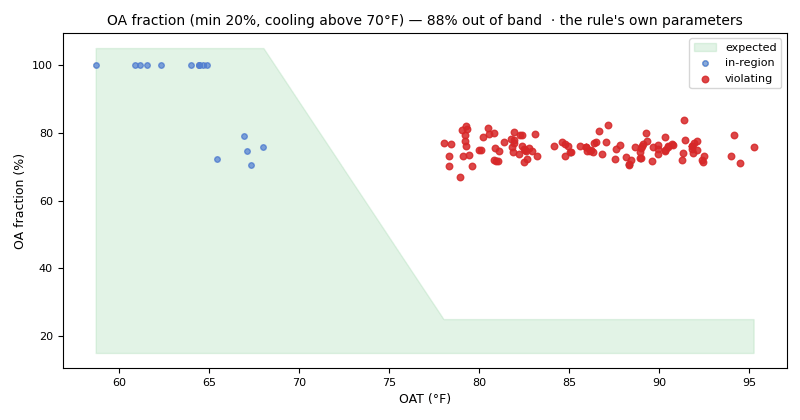
Synthetic illustration, not this exercise's dataset: the outdoor_air_fraction evidence chart for a damper stuck about 75 % open. The band is the rule's own minimum and changeover; red points are the cooling-weather samples it counts as excess outdoor air.
Caveats
- The data are simulated: one unit, one climate, one control sequence. Real dampers stick part way, drift, or stick only in some weather.
- The outdoor-air fraction here comes from a temperature balance (mixed, return and outdoor air); it is unreliable when the outdoor and return temperatures are close, and CAMBER leaves those samples out.
- The low limit is a property of this unit's sequence, not a general value: another unit may lock out at a different temperature, or not at all. Set it from the unit's own sequence, or from a winter of known-good trends (the outdoor temperature below which the damper command never leaves its minimum), never to make a finding go away.
- The 100 % damper run is shorter than the others (
_short), so it has fewer free-cooling hours. - The simulated schedule runs one weekday late; see the dataset's data issues.
- The Irish unit is real and unlabelled: its findings are hypotheses to check with the site, not scored detections. Ireland rarely reaches cooling weather, so the "cooling weather" samples (outdoor air above 70 °F) are few.
Going further
- Re-run with the dataset's default config (
camber datasets config lbnl-sdahu --store
  lab_store --out sdahu.json
) and compare what it reports. - Try a generic 20 % design minimum in
econ.json(min_oa_pct) and see which verdicts change. - The spliced run
AHU__onset_damper_stuck_025switches from fault-free to a stuck damper part way through the year: can you see when, in the trend viewer? - Split the Irish record by period: add
"start"and"end"to thesourceblock ofirish.json(for example before 2020-03 and from 2020-08 to 2021-12) and re-run.