Terminal units: the reheat penalty and overcooling at minimum airflow
Workbook exercise zone-reheat-overcooling · PNNL re-tuning chapter 7 · about 45 minutes
Goal
Find the terminal boxes that cool a zone and then heat the same air back up. Tell the two causes apart: a minimum airflow set so high that a healthy box overcools its zone, and a stuck damper that pushes far more air than the box asks for. Then check which box in the data is the one under test, and score CAMBER against the published fault labels.
Learn more
Read these first (PNNL, free):
- Zone Heating and Cooling Control, the re-tuning guide for zones: read what it says about terminal-box minimum airflow and about reheat, the two halves of this exercise.
- Chapter 7: Terminal Units in Air Distribution System of the re-tuning training, for how a terminal box's airflow and reheat are meant to work together.
Datasets and licence
lbnl-fpu: LBNL's simulated fan-powered VAV terminal boxes on one air handler, a year at one-minute resolution, as a fault-free run plus labelled faulted runs. Licence CC-BY-4.0 (open; cite it). The download is one 2.2 GB archive; the default subset ingests five of its runs. The catalog lists the problems found in the published data and how CAMBER handles each: see its data issues.
The default subset holds five runs of the parallel fan-powered box, each one piece of equipment
in the facility ds-lbnl-fpu: PFPU__fault_free, the box damper stuck half and fully open
(PFPU__VAVDMPRStuck_50pct, PFPU__VAVDMPRStuck_100pct), the reheat valve stuck shut
(PFPU__ReheatVLVStuck_0pct) and a leaking reheat valve (PFPU__ReheatVLVLeak_50pctMaxFlow).
Which box is under test? Each simulated run has four boxes, one per zone (interior, west,
south and east). The faults are imposed on one of them only. CAMBER maps the south-zone box
(_S columns), because comparing each faulted run with the fault-free one shows that only the
_S box's columns change. Until 0.82 CAMBER mapped the west box and scored a healthy one.
Setup
In the lab
- Run
camber laband open the URL it prints (http://127.0.0.1:8765/lab?token=...). - Tick
lbnl-fpuand press Fetch & ingest (a 2.2 GB download: start it early). - When the job is done, the row links to trends (the trend viewer) and report (the dataset's default config). This exercise uses its own config: use the command line for step 2 of the steps below, and the lab's trend viewer to look at the data.
On the command line
camber datasets fetch lbnl-fpu
camber datasets ingest lbnl-fpu --store lab_store
camber datasets config lbnl-fpu --exercise zone-reheat-overcooling --store lab_store --out fpu.json
camber run fpu.json --out fpu_out
camber datasets score lbnl-fpu --store lab_store --findings fpu_out/findings.json
The exercise's config (--exercise zone-reheat-overcooling) runs four rules on each run's box:
airflow_tracking: is the airflow following its setpoint?reheat_penalty: is the box reheating air that was cooled centrally?overcooling_min_flow: is the zone overcooled while the box sits at its minimum airflow?unmet_setpoint_hours: how often is the zone outside its setpoints?
The box trends both the controller's reheat demand and the valve's measured position. Since
0.98, reheat_penalty and overcooling_min_flow read the position (their findings say so in
valve_signal), because they ask whether heat was actually delivered; the rules that ask how hard
the controller calls for heat keep reading the demand. Keep that in mind for question 5. camber report fpu.json --out fpu.html gives the same findings as a
report, with their evidence charts; add --layout rcx for the printable RCx report, with a
page per issue.
Steps
- Look before you judge. In the trend viewer, open
PFPU__fault_freefor a winter weekday. Plot the airflow against its setpoint, the reheat valve, the zone temperature and its two setpoints. When does the box reheat, and at what airflow? - Run the exercise's config (the commands above) and read the findings
camber runprints. - The healthy box. Find
overcooling_min_flowandreheat_penaltyforPFPU__fault_free. How often does it sit at its minimum with the zone below its cooling setpoint? What is that minimum as a share of its peak airflow? - The stuck dampers. For the two
VAVDMPRStuckruns, compare the airflow with its setpoint (airflow_tracking), the share of occupied hours with reheat (reheat_penalty) and the cold hours (unmet_setpoint_hours). - The valve runs. Read the same rules for
PFPU__ReheatVLVStuck_0pctandPFPU__ReheatVLVLeak_50pctMaxFlow. - Score. Run
camber datasets scoreon the findings and read the per-detector rates.
Questions
- Does the fault-free box overcool its zone? How often does it sit at its minimum airflow with the zone already below the cooling setpoint, and what is that minimum as a share of the box's peak airflow?
- How often does the fault-free box reheat, and why does that count as a (small) penalty rather than normal operation?
- How far off its setpoint is the airflow of the box whose damper is stuck fully open, and how often does that box reheat? Compare it with the half-open damper.
overcooling_min_flowstays quiet on the stuck-open box, even though it overcools its zone more than any other run. Why?- The box with its reheat valve stuck shut: what do
reheat_penaltyandovercooling_min_flowsay about it, and what does the caveat on their findings tell you? What would a rule that only had the controller's demand have said? - Which box, of the four in each simulated run, is the device under test, and how would you check that yourself?
- What true- and false-positive rates does the label score give
airflow_tracking, and which faulted runs does the overall score count as missed?
What CAMBER shows
- Findings.
camber runprints one line per finding with its severity (fault,warn,ok);fpu_out/findings.jsonholds every metric, e.g.mean_abs_rel_errorforairflow_tracking,valve_open_pctforreheat_penalty,overcool_at_minflow_pctandmedian_minflow_fractionforovercooling_min_flow,too_cold_pctforunmet_setpoint_hours. - Evidence. In the report,
overcooling_min_flowshades the hours when the zone runs well below its cooling setpoint, andreheat_penaltycompares the reheat valve with the discharge-air rise. - Score.
camber datasets scoreprints the true- and false-positive rates, with 95 % intervals, for the dataset's declared detectors (here onlyairflow_tracking), and which rules fired on each labelled run.
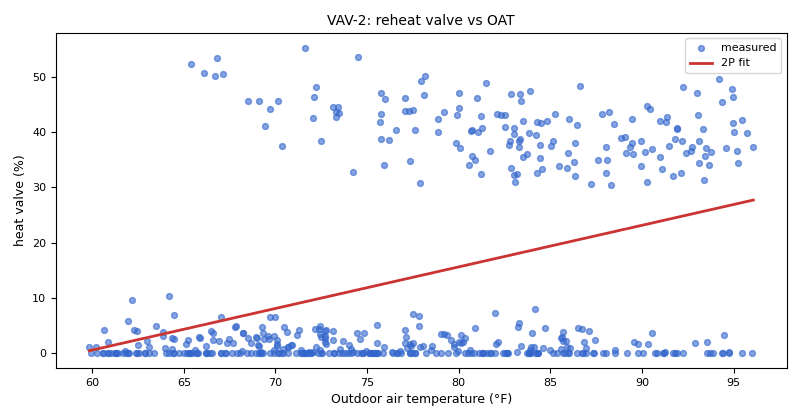
Synthetic illustration, not this exercise's dataset: the reheat_penalty evidence chart, reheat valve against outdoor temperature. Reheat held open on 80 to 95 °F days is energy spent undoing the cooling.
Caveats
- The data are simulated: one building, one climate, one control sequence, and a fault held all year. A real stuck damper sticks at some unknown position on some unknown day.
- A site that trends only the controller's demand cannot tell a valve that opens from one that
cannot: map the demand as
heat_valveand, where it exists, the measured position asheat_valve_position. A leaking valve is invisible to both. - In a parallel fan-powered box, the box fan adds warm plenum air when it runs, so the discharge
air rises a few degrees even with the reheat valve shut. The exercise sets
reheat_penalty'sfan_heat_fto"auto", which measures that lift per box (fan_heat_fin the metrics) and allows for it in the valve-versus-discharge check. The entering-air reading is the air handler's supply temperature, a proxy. - The rules judge weekdays 07–18 (their default schedule). The simulated building starts its occupied setpoints at 06:00.
Going further
- Run the dataset's default config (
camber datasets config lbnl-fpu --store lab_store --out
  fpu_default.json
) and compare: which of this exercise's findings are missing? - The
fullsubset (camber datasets ingest lbnl-fpu --subset full --store lab_store) adds the series fan-powered box and the other faults: airflow-sensor biases, reheat-coil fouling, unstable control. Which of them doesairflow_trackingcatch? - Continue with
zone-reheat-saturated: what the stuck-shut valve looks like to a rule built for it.