Duct static pressure: a fixed setpoint and the damper census
Workbook exercise air-static-pressure · PNNL re-tuning chapter 5 · about 40 minutes
Goal
Find out whether an air handler's duct static-pressure setpoint is reset, and use the terminal boxes' damper positions to judge whether the static it holds is higher than the zones need. A static setpoint held high all day makes the supply fan work against boxes that are throttling the extra pressure away.
Learn more
Read these first (PNNL, free):
- AHU Static Pressure Control, the re-tuning guide: its questions ask whether the static setpoint is reset, and whether the terminal dampers show the static is too high or too low. Each half of this exercise answers one of them.
- Chapter 5: Air Handling Units of the re-tuning training, for the static-pressure trends and the damper-position census.
Datasets and licence
lbnl-sdahu: LBNL's simulated single-duct VAV air handler, a year at one-minute resolution, fault-free plus labelled faulted runs. Licence CC-BY-4.0 (open; cite it). About 600 MB to download. Its static-pressure points have two published problems, both handled at ingest: see its data issues.ornl-frp-vav: a real two-storey test building at ORNL, one rooftop unit and ten VAV boxes logged at one-minute resolution, one day per test scenario. Licence CC-BY-4.0 (open; cite it). About 8 MB. See its data issues.
The equipment used: AHU__fault_free (and the faulted runs) in ds-lbnl-sdahu, and the ten
boxes RTU_VAV_<room>__d3_fault_free of the fault-free test day in ds-ornl-frp-vav. The LBNL
units do not trend their zone boxes' dampers, and the ORNL rooftop unit does not trend its static
setpoint, which is why the exercise needs both datasets.
Setup
In the lab
- Run
camber laband open the URL it prints (http://127.0.0.1:8765/lab?token=...). - Tick
lbnl-sdahuandornl-frp-vavand press Fetch & ingest. - Use each row's trends link to look at the data; the exercise's own configs are run from the command line.
On the command line
camber datasets fetch lbnl-sdahu ornl-frp-vav
camber datasets ingest lbnl-sdahu ornl-frp-vav --store lab_store
camber datasets config lbnl-sdahu --exercise air-static-pressure --store lab_store --out sp.json
camber run sp.json --out sp_out
camber datasets config ornl-frp-vav --exercise air-static-pressure--ornl-frp-vav --store lab_store --out census.json
camber run census.json --out census_out
sp.jsonrunsstatic_pressure_reset: does the trended static setpoint move, on enough days, and with the supply airflow, as a trim-and-respond reset would?census.jsonrunsdamper_censusover the ten boxes of one test day: each box's median damper opening in occupied hours, and the share of boxes throttling below 50 % open or pinned at 90 % and above.
Steps
- Look first. In the trend viewer, plot
AHU__fault_free's duct static setpoint and its supply airflow for a week. Then plot two or three ORNL boxes' damper positions on the fault-free day. - Run both configs and read the findings.
- The setpoint. Read
static_pressure_resetonAHU__fault_free:sp_range_inwc,sp_median_inwcandsp_behaviour. Then look for the same rule on a faulted run such asAHU__damper_stuck_075. - The census. Read
damper_census:n_boxes,median_damper_pct,pct_boxes_low,pct_boxes_highandoccupancy_gate, and the verdict line.
Questions
- Is the single-duct unit's static setpoint reset? What value does it hold?
- Why is there no static-pressure finding at all on the faulted single-duct runs?
- What does the damper census say about the ORNL building's duct static on the fault-free day, and what would you propose?
- What else, besides a static setpoint that is too high, could leave every box throttled in this building?
What CAMBER shows
- Findings.
static_pressure_resetreports the setpoint's range and median, the number of days it moved and the driver it was checked against;damper_censusis one finding for the whole group of boxes (<fleet>), with the per-group shares. - Data issues.
camber datasets info lbnl-sdahulists how the published static points were corrected at ingest;camber datasets info ornl-frp-vavlists the test days whose duct static collapsed. - Report.
camber report sp.json --out sp.htmlshows the same findings as a report, with their evidence charts; add--layout rcxfor the printable RCx report, with a page per issue.
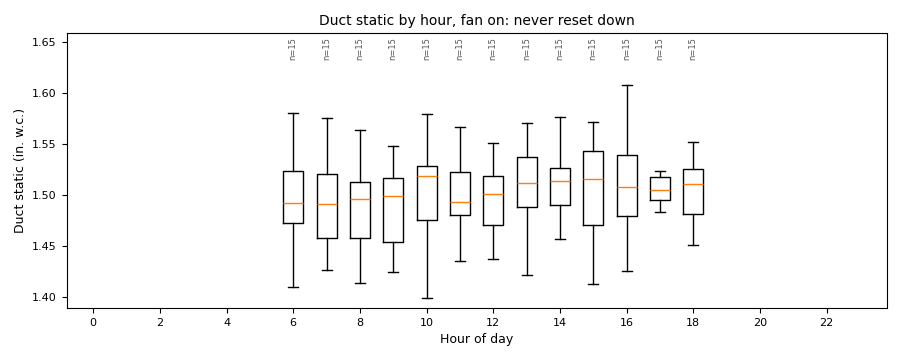
Synthetic illustration, not this exercise's dataset: the RCx report's air-distribution chart, duct static by hour of day on fan-on samples. One flat band at every hour is a static setpoint that is never trimmed back at light load.
Caveats
- The single-duct unit is a simulation with a fixed sequence: a flat setpoint is its design, and the exercise asks what re-tuning would change.
- The ORNL tests are research tests, one day each: only the box under test was actively
controlled, and the publisher advises treating the other rooms' data as supplementary (see
camber datasets info ornl-frp-vav). Read the census as a screening signal for this day, not a verdict on the building's design. damper_censusjudges each box's occupied hours from the box's own trended occupancy point (the tests ran 07:00-22:00 every day), so a weekend test day gets a census too. A box with no occupancy trended falls back to CAMBER's assumed weekday 07:00-18:00 schedule; the finding'soccupancy_gatesays which applied (trended occupancy, the assumed schedule, ormixed).- The census pools the boxes you give it. Mixing boxes from different air handlers, or different test days, mixes different static pressures.
Going further
- Point the census at a stuck-damper day, for example the boxes of
d3_stuck_080, or ofd3_stuck_000, a weekend day (edit theequiplist incensus.json), and compare it with the fault-free day. camber datasets info ornl-frp-vavdescribes five test days in other subsets where the static collapsed; fetch thefullsubset and run the census on one of them.- The exercise
air-sat-resetlooks at the other reset an air handler should have.