Capstone: RCx report, walk-down, re-tuning plan and verification
Workbook exercise capstone · PNNL re-tuning chapters 9 and 10 · about 2 hours
Goal
Run a re-tuning project end to end on open data. Build the RCx report for an air handler whose outdoor-air damper sticks part way through the year, turn its issues into a walk-down checklist and a re-tuning plan, then verify: with drift detection on the fault-onset series, and with a before-and-after test of a scheduling measure, where you will also find out what M&V a one-week test can and cannot support.
Learn more
Read these first (PNNL, free):
- Air-Side Economizer Operation, the re-tuning guide behind the report's economizer issue.
- Chapter 9: Building Walk Down of the re-tuning training: what to look at on site, and how the walk-down feeds the re-tuning.
- Chapter 10: Re-Tuning Building Controls and Systems: making the changes and checking that they hold.
Datasets and licence
lbnl-sdahu: LBNL's simulated single-duct VAV air handler, a year at one-minute resolution. Licence CC-BY-4.0 (open; cite it). About 600 MB to download. See its data issues. CAMBER splices two of its runs into a fault-onset series,AHU__onset_damper_stuck_025: the fault-free run until 2018-07-01, then the run with the outdoor-air damper stuck at 25 %.AHU__fault_freeis its control.ornl-frp-ops: a real multizone office test building at ORNL, one rooftop unit and ten VAV boxes, run through designed operating tests at one-minute resolution. Licence CC-BY-4.0 (open; cite it). About 14 MB. See its data issues. The default subset holds the heating baseline test (RTU__base_heating, the unit on around the clock) and the heating setback test (RTU__sb_heating), about a week each in different winters; they play "before" and "after" a scheduling measure.
Setup
In the lab
- Run
camber laband open the URL it prints (http://127.0.0.1:8765/lab?token=...). - Tick
lbnl-sdahuandornl-frp-opsand press Fetch & ingest. - Use trends to look at
AHU__onset_damper_stuck_025around 1 July, and at the two RTU tests at night. The runs below use the command line.
On the command line
camber datasets fetch lbnl-sdahu
camber datasets fetch ornl-frp-ops
camber datasets ingest lbnl-sdahu ornl-frp-ops --store lab_store
camber datasets config lbnl-sdahu --exercise capstone --store lab_store --out cap.json
camber run cap.json --out cap_out
camber report cap.json --layout rcx --out cap_rcx.html
The exercise config runs the economizer rules with this unit's own design minimum and high
limit, and free_cooling_missed with the economizer low-limit lockout you found in the
economizer exercise (low_limit_f 33.8), plus the supply-air and
static-pressure rules, on the onset series and its control; read its _comment. Write the RCx report before you freeze drift baselines: once they exist,
camber run and camber report fold the drift verdicts in. Then, for verification:
camber drift freeze cap.json
camber drift run cap.json
camber datasets config ornl-frp-ops --store lab_store --out ornl.json
camber run ornl.json --out ornl_out
The drift section freezes a baseline on January to June and scores July to December. For the M&V attempt on the RTU tests, in Python:
from camber.mandv.caltrack import caltrack_savings_hourly
from camber.model.roles import Role
from camber.store import ParquetStore

store = ParquetStore("lab_store")


def hourly(equip, role):
    frame = store.read_role_frame(facility_id="ds-ornl-frp-ops", equip=equip, resample="1h")
    return frame[role]


caltrack_savings_hourly(
    hourly("RTU__base_heating", Role.POWER),
    hourly("WEATHER__base_heating", Role.OAT),
    hourly("RTU__sb_heating", Role.POWER),
    hourly("WEATHER__sb_heating", Role.OAT),
)
Steps
- Read the report. Open
cap_rcx.html. Read the executive summary: every issue's rank, equipment, severity, confidence and action. Open each issue page, the data-coverage page and Appendix A (declines and data gaps). - Build the walk-down checklist. Before you read the report's Verify on site section, write your own from the rest of the report. Collect:
- every recommended action that asks you to check or verify something in the field;
- every conditional issue: the point it depends on is a sensor or setpoint to verify;
- every confidence line that says the rule used defaults because no site parameter was configured: a design value to confirm on site (minimum outdoor air, high limit, setpoints);
- anything in Appendix A that only a site visit can settle. For each item write what to look at, where, and what result would confirm or clear it. Then compare yours with the generated section: sensors first, then equipment, then design values the checks assumed, then points the checks lacked. What did it list that you missed, and what does your list have that a template cannot know?
- Write the re-tuning plan. For each issue you keep after the walk-down, one line: the change, who makes it, what could go wrong, how you will verify it (which CAMBER check, which window) and what result counts as done. Order it: sensors first, then the equipment, then the sequences.
- Verify by drift. Run
camber drift freezeandcamber drift run. Read each unit's locus, severity and the economizer signal. - Verify a scheduling measure. Run
ornl.json. Comparenight_weekend_setbackandcompressor_short_cyclebetween the baseline and setback tests. Then run the M&V snippet.
Questions
- Which issue does the report rank first, on which unit, at what severity and confidence? None
of the issues has a cost here: what puts this one above the others? What cause does its
heading name, what evidence in the
free_cooling_missedfinding supports that cause (missed_cause,commanded_open_pct), and what should the walk-down still confirm before anything is repaired? - How often did the onset unit run mechanical cooling in free-cooling weather, against the control? Which hours does the rule judge, how does a damper stuck for half the year still read as a fault over the whole year, and why do the outdoor-air-fraction rules stay quiet on it?
- Which issue is conditional, on what, and with what trust? What goes on the walk-down list for it?
- Write your walk-down checklist and your re-tuning plan (steps 2 and 3). How does your checklist compare with the report's Verify on site section?
- What does drift report for the onset unit and for the control? How would you use the same frozen baseline after the damper is repaired?
- What do the setback verdicts say before and after the scheduling measure, and did the measure fix the compressor's short cycling (starts per day before and after)?
- What does CAMBER say when asked for an hourly M&V saving from the two RTU tests? What would a defensible measurement of this measure need?
What CAMBER shows
- RCx report (
--layout rcx): the ranked issues with severity, confidence and "why we believe this", cost or "uncosted" with the reason, the recommended action, conditional and dependent notes; data coverage and sensor trust; the economizer page; the Verify on site walk-down checklist (per issue: what to look at, which point, what would confirm or refute it; linked to PNNL Re-tuning chapter 9); Appendix A's declines. - Findings (
cap_out/findings.json):free_cooling_missed'smissed_pctand why the free cooling was missed (missed_cause: the damper was commanded open but did not deliver outside air, or the economizer never commanded it open;commanded_open_pct), the outdoor-air-fraction and high-limit verdicts, the supply-air and static-pressure checks. - Drift (
camber drift run): one verdict per unit with itslocus(outdoor-air,steady...), severity and each detector's signal; the threshold notes printed with it. - ORNL findings:
night_weekend_setback(fan runtime and, when the fan cycles, the held setback temperature) andcompressor_short_cycle(starts_per_day,runtime_pct). - M&V:
caltrack_savings_hourlyeither returns a saving with its band or refuses, saying why. A refusal for too little baseline data also says what data is needed: the exception'sneedattribute (e.need["text"]) gives the hours required, available and still missing.
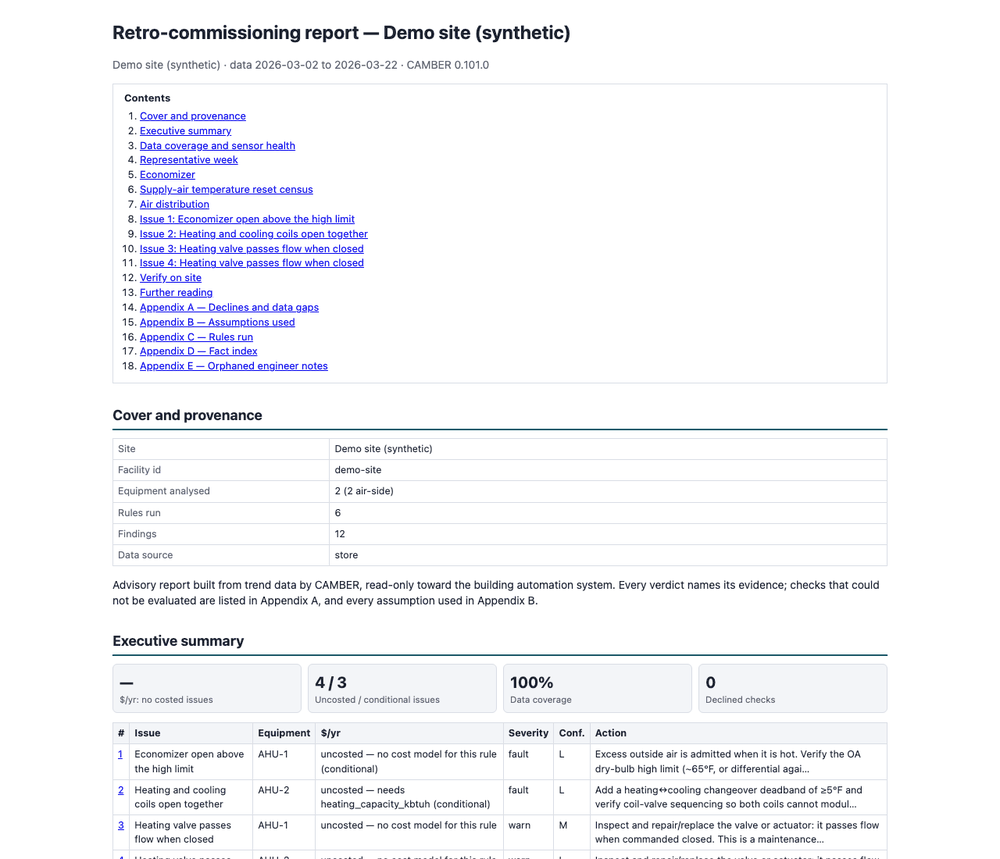
Synthetic data: the opening of an RCx report (--layout rcx) for a two-AHU demo site: the contents, the cover and the executive summary's issue table.
Caveats
free_cooling_missedjudges the whole year (its fan-on hours): a damper that sticks on 1 July shares its free-cooling hours with six healthy months, so the yearly share understates it. Drift, which compares the two halves, is the check built for an onset.- The onset series is a splice of two simulations, not one unit breaking; the "before" and "after" are perfect twins except for the damper.
- The damper and valve points map to the controller's demand signals, so the command keeps moving while the damper is stuck: that is what drift sees, and also why the command alone would never show the fault. The report's cause comes from setting the command against the mixed-air temperature.
- Drift thresholds are screening-grade and its timing parameters untuned; a drift verdict ranks equipment for a walk-down, it does not dispatch a repair.
- The ORNL tests were run in different winters, a week each; a before-and-after comparison of them is not weather-normalized.
- The report's recommended actions are generic; the walk-down decides what applies.
Going further
- In a copy of
cap.json, pointdrift.storeat a new file and narrowdrift.currentto one week of July, then one week of December: does drift see the stuck damper as early as it sees it late? - Add
report.loadssizing tocap.json(see RCx report) and see which issues get a cost. - Use
camber report cap.json --layout rcx --notes-template notes.jsonto write your walk-down findings into the report as engineer's notes: thesection:verifyslot holds the walk-down's results next to the generated checklist.