What excess outside air costs
Workbook exercise air-excess-oa-cost · PNNL re-tuning chapter 6 · about 45 minutes
Goal
Find an air handler that holds more outside air than its design minimum, and put a price on it. Follow the estimate through the three things extra outside air can do: cost cooling in hot or humid hours, cost heating in cold ones, and cost nothing while the unit economizes. Then see what the estimate needs from you, and what it does when an input is missing.
Learn more
Read these first (PNNL, free):
- AHU Minimum Outdoor-Air Operation: how to find a minimum outside-air setting that is too high, and why the minimum damper position is not the outside-air fraction.
- Air-Side Economizer Operation: when outside air above the minimum is free cooling and when it is a load, and the high-limit choices that decide it.
- Chapter 6: Economizer Operations of the re-tuning training, for reading the mixed, return and outdoor air trends together.
Datasets and licence
synthetic-ahu-excess-oa: two synthetic variable-air-volume air handlers that CAMBER generates on your computer. Nothing is downloaded and no real building is behind them. They trend the outdoor and return air temperature and relative humidity, the mixed and supply air temperatures, the supply-air setpoint, the outdoor-air damper, the supply airflow, the heating and cooling valves, the fan status and the occupancy point, every 15 minutes for six weeks of a humid spring turning to early summer. Licence Apache-2.0 (CAMBER's own; the data may be shared). About 0.7 MB. See synthetic datasets for how CAMBER generates it.
The facility ds-synthetic-ahu-excess-oa holds three equipment: AHU__excess_oa,
AHU__economizer, and AHU__excess_oa_no_flow, which is AHU__excess_oa's data read without
its supply airflow point, as a BAS with no airflow station would trend it. Both units declare a
20 % design minimum outside air. How each one runs is for you to find.
Setup
In the lab
- Run
camber laband open the URL it prints (http://127.0.0.1:8765/lab?token=...). - Tick
synthetic-ahu-excess-oa(its kind readssynthetic) and press Fetch & ingest. CAMBER generates the file instead of downloading it, then ingests it like any other dataset. - When the job is done, the row links to trends (the trend viewer) and to report. The cost is in the RCx layout, which the steps below build on the command line.
On the command line
camber datasets fetch synthetic-ahu-excess-oa
camber datasets ingest synthetic-ahu-excess-oa --store lab_store
camber datasets config synthetic-ahu-excess-oa --exercise air-excess-oa-cost --store lab_store --out oa.json
camber run oa.json --out oa_out
camber report oa.json --layout rcx --out oa_rcx.html
camber datasets score synthetic-ahu-excess-oa --store lab_store --findings oa_out/findings.json
The exercise's config runs outdoor_air_fraction with the units' declared minimum
(min_oa_pct 20) and economizer_high_limit with the same minimum and the economizer's 65 °F
dry-bulb high limit; read its _comment. Two variants change one input each: no declared
minimum, and a design outdoor airflow for the unit without an airflow point:
camber datasets config synthetic-ahu-excess-oa --exercise air-excess-oa-cost--no-min --store lab_store --out oa_nomin.json
camber report oa_nomin.json --layout rcx --out oa_nomin_rcx.html
camber datasets config synthetic-ahu-excess-oa --exercise air-excess-oa-cost--design-oa --store lab_store --out oa_design.json
camber report oa_design.json --layout rcx --out oa_design_rcx.html
For step 5, the same unit without its humidity points, in Python:
from camber.fault_economics import cost_findings
from camber.model.roles import Role
from camber.rules.oafraction_rule import OutdoorAirFraction
from camber.store import ParquetStore

store = ParquetStore("lab_store")
frame = store.read_role_frame(facility_id="ds-synthetic-ahu-excess-oa", equip="AHU__excess_oa")
dry = frame.drop(columns=[Role.OUTDOOR_RH, Role.RETURN_AIR_HUMIDITY])
finding = OutdoorAirFraction(min_oa_pct=20).analyze("AHU__excess_oa", dry)
print(finding.metrics["oa_cost_cool_h"], finding.metrics["oa_cost_economizing_h"])
print(cost_findings([finding])[0].annual_cost_usd)
Steps
- Look before you judge. In the trend viewer, plot each unit's outdoor, return and mixed air with its outdoor-air damper over a cold morning in the first week and a hot afternoon in the last. Work out each unit's outside-air fraction by hand from the three temperatures.
- Run the exercise's config and read
outdoor_air_fractionfor each unit inoa_out/findings.json: the severity,oaf_median_pct,median_oaf_coolingandexcess_oa_pct. Then read theoa_cost_*metrics ofAHU__excess_oa: the cooling, heating and economizing hours, the cooling and heating bases, the airflow and the observed hours. - Read the price. Open
oa_rcx.html: the executive summary, theAHU__excess_oaissue page, and the excess-outside-air table in Appendix B. - The economizer. Find
AHU__economizerin the findings and in the report. - Without humidity. Run the Python above and compare its hours and dollars with step 2 and step 3.
- No airflow. Find
AHU__excess_oa_no_flowin the report and in Appendix B. - No declared minimum. Build the
no-minreport and compare the verdicts, Appendix B and the totals with step 3. - A design airflow. Build the
design-oareport and readAHU__excess_oa_no_flowagain.
Questions
- Which unit holds excess outside air, how much, and against what minimum? How does
economizer_high_limitjudge it differently fromoutdoor_air_fraction? - Of the unit's excess hours, how many does the estimate read as cooling, as heating and as economizing? Which of them cost money?
- What does the RCx report price the unit at, how much of it is cooling electricity and how much heating gas, and how does a six-week trend become an annual figure? Both rules flag the unit: why is the issue's cost not their sum?
- The economizer also spends hours above its minimum. What does it cost, and why?
- Without the humidity points, how many hours move from cooling to economizing, and what happens to the estimate? Which reading is right for a humid climate, and why?
- What does the report say about the unit with no airflow point, and why does it not guess?
- With no declared minimum, what changes in the verdicts and what changes in the cost? Why does CAMBER price only a minimum the site declared?
- Priced from a design outdoor airflow, how does the no-flow unit's estimate compare with the same unit's trended airflow estimate, and why?
What CAMBER shows
- Findings.
outdoor_air_fractionreports the outside-air fraction from the mixing-box temperature balance on occupied fan-on samples:oaf_median_pct,median_oaf_cooling(above the 70 °F cooling cutoff) andexcess_oa_pct, the share of cooling-weather samples more than 5 points above the minimum. It warns at 20 % and faults at 50 %.economizer_high_limitjudges only the samples above its high limit. - Cost inputs. Both rules carry
oa_cost_*metrics: each excess sample read as cooling (oa_cost_cool_h, by enthalpy when the outdoor and return humidity are trended, else by dry bulb), heating (oa_cost_heat_h, colder outdoor air while the heating valve is open) or economizing (oa_cost_economizing_h, priced at zero), andoa_cost_observed_h, the hours the period covers.min_oa_sourcesays whether the minimum was declared. - The price. The RCx report (
--layout rcx) prices a warn or fault verdict. Cooling is4.5 × cfm × e × (h_OA − h_RA)Btu/h atcool_cop(3.5), heating1.08 × cfm × e × (RAT − OAT)atboiler_efficiency(0.80), whereeis the excess fraction above the minimum. The period is scaled byannual_hours / observed hours. Appendix B lists every estimate's minimum, airflow, bases and hours, or the input it needs. See Excess outside air cost. - Score.
camber datasets scoreprints the true- and false-positive rates foroutdoor_air_fraction.
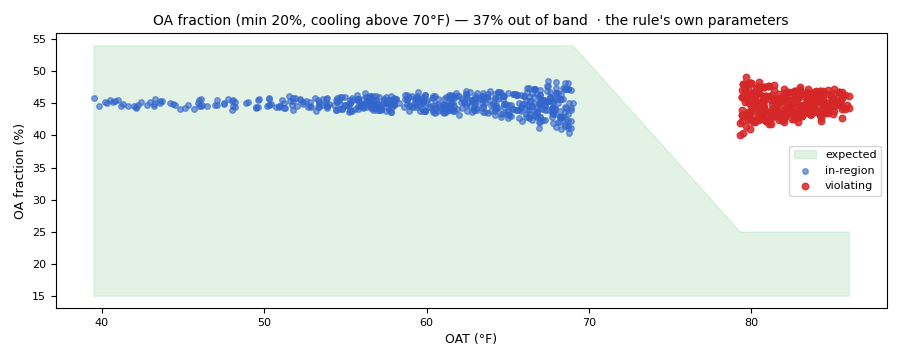
From this exercise's synthetic unit AHU__excess_oa: the outdoor_air_fraction evidence chart at the declared 20 % minimum. Every occupied fan-on sample sits near 45 %; above the 70 °F cooling cutoff they fall outside the band. Samples within 5 °F of the return air are left out (the balance divides by their difference).
Caveats
- The data are synthetic: CAMBER's own model of two air handlers, built to show this fault. They show what the rules and the estimate see, not how real units behave; never cite them as evidence about a building.
- The estimate prices the extra air at the coil. It does not model the fan, the plant's part-load efficiency or the humidity a unit removes later in the space.
- An annualised figure from six weeks of spring is an extrapolation: it assumes the rest of the year looks like those weeks. A year of trends prices the year.
- A minimum outside-air fraction comes from the unit's ventilation design (ASHRAE 62.1) or a measurement at the minimum damper position, never from the damper command alone.
Going further
- Run
camber rules params outdoor_air_fractionandcamber rules params economizer_high_limitto see where each default comes from. - Read the minimum outside air exercise: how is the design minimum itself checked against 62.1?