RCx cause chains: one air handler, many boxes
Workbook exercise rcx-cause-chains · PNNL re-tuning chapters 5 and 7 · about 40 minutes
Goal
An air handler that cannot cool its supply air, or cannot make its duct static, shows up first at the boxes it serves: zones that run warm, boxes short of air. A retro-commissioning report that lists every box finding as its own issue buries the one fix that clears them all, and adds up the same waste several times. Read the RCx report's cause chains: which air handler explains which boxes, which box problem is the box's own, and what the report does without a served-by topology.
Learn more
Read these first (PNNL, free):
- Chapter 5: Air Handling Units of the re-tuning training: the supply-air temperature and duct static an air handler has to hold, and what to trend to see it do so.
- Chapter 7: Terminal Units in Air Distribution System: what a VAV box can and cannot do when its air handler falls short.
Datasets and licence
synthetic-g36-rcx-chains: a synthetic VAV system that CAMBER generates on your computer, the same model as the G36 fleet exercise. Nothing is downloaded and no real building is behind it. Each air handler trends its supply-air temperature, duct static pressure, their setpoints and reset requests, its supply fan's speed and its cooling valve. Each of its six single-duct reheat boxes trends its space temperature and setpoints, airflow and airflow setpoints, damper, reheat valve and loops. The data is hourly, for three weeks of spring. Licence Apache-2.0 (CAMBER's own; the data may be shared). About 0.8 MB. See synthetic datasets for how CAMBER generates it.
Five air handlers are ingested with their boxes in the facility ds-synthetic-g36-rcx-chains:
AHU__<name> and VAV1__<name> to VAV6__<name>, where the name is one of healthy,
one_bad_box, warm_sat, low_static and cold_sat. Boxes 1 to 4 face east, west, south and
north; boxes 5 and 6 are interior. The run template declares which boxes each air handler serves
and how big each unit's reheat coil is, so the report can cost reheat.
Setup
In the lab
- Run
camber laband open the URL it prints (http://127.0.0.1:8765/lab?token=...). - Tick
synthetic-g36-rcx-chains(its kind readssynthetic) and press Fetch & ingest. - When the job is done, the row links to trends and to report. The steps below use the command line.
On the command line
camber datasets fetch synthetic-g36-rcx-chains
camber datasets ingest synthetic-g36-rcx-chains --store lab_store
camber datasets config synthetic-g36-rcx-chains --exercise rcx-cause-chains --store lab_store --out chains.json
camber run chains.json --out chains_out
camber report chains.json --layout rcx --out chains_rcx.html
camber datasets score synthetic-g36-rcx-chains --store lab_store --findings chains_out/findings.json
The variant without the topology, to compare:
camber datasets config synthetic-g36-rcx-chains --exercise rcx-cause-chains--no-topology --store lab_store --out chains_flat.json
camber report chains_flat.json --layout rcx --out chains_flat_rcx.html
Steps
- Look before you read the report. In the trend viewer, plot
AHU__warm_sat's supply-air temperature with its setpoint and cooling valve,AHU__low_static's duct static with its setpoint and fan speed, andAHU__cold_sat's supply-air setpoint. Then plot two boxes of each with their space temperature, cooling setpoint, airflow and airflow setpoint. - Run the exercise's config and open
chains_rcx.html. Read the executive summary's issue table, then each issue page: its cause, its members, the cause-chain line and its cost. - The box on a healthy air handler. Find
VAV3__one_bad_boxin the report. Plot its damper and airflow. - Score. Run
camber datasets scoreand read the rates of the six rules it scores. - Without the topology. Build
chains_flat_rcx.htmland compare: the number of issues, the costed total and Appendix A.
Questions
- Which three air handlers root an issue with a cause chain, and what does each chain say (cause, symptom, how many boxes)? Why is the north box missing from two of them?
- Which rule's finding roots each chain? What on the air handler did it see?
- The cold-supply chain has two costed members. What does the report give as the issue's cost, and why not their sum?
- Why is
VAV3__one_bad_boxits own issue, twice, and not part of any chain? What would you check on site? - Without the topology, how many issues does the report rank, what is its costed total, and what does Appendix A say? Which report would you hand to the operator, and why?
What CAMBER shows
- Cause chains. With a declared served-by topology, the RCx report makes an air handler's
finding the root of an issue whose members include the matching findings on the boxes it
serves. Three chains exist: supply air too warm (a G36 FC13 in
g36_afdd, orsupply_air_controltoo warm) with zones that cannot cool (unmet_setpoint_hourstoo hot); supply air too cold (supply_air_reset, or the below-target side ofsupply_air_reset_compliance) with overcooling and reheat at the boxes; and duct static too low (a G36 FC1) with starved boxes (airflow_trackingbelow setpoint, or a zone that cannot cool). The issue says how many of the boxes the air handler serves are linked ("N of M boxes"). - Cost. An issue's cost is its largest costed member, never the sum: the members are views of one waste. Its hours are the union of its members' hours.
- No guessing. Without a declared topology, or for a box the topology does not cover, nothing links: each finding is its own issue, and Appendix A lists the boxes left unlinked and the air-handler causes found.
- Score.
camber datasets scorescores the six rules the entry labels; the chains themselves are a report view, not a rule, and are not scored.
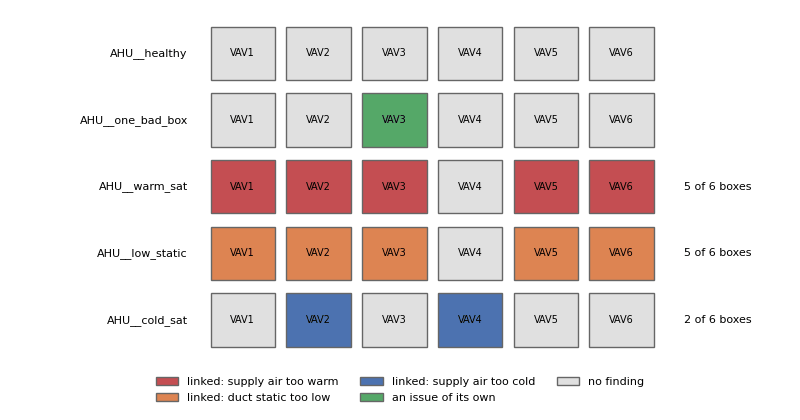
From this exercise's synthetic air handlers: each box coloured by the issue the RCx report puts its findings in.
Caveats
- The data are synthetic: CAMBER's own model of a VAV system, built to show these chains. They show what the report does, not how real systems behave; never cite them as evidence about a building.
- The fan speed and cooling valve are simple stand-ins, enough for the air-handler rules to judge supply air and duct static.
- The chains rest on the topology you declare. A wrong served-by map links the wrong boxes; the report cannot tell.
- The costs come from the coil sizes the run template declares, and only reheat is costed here. The chains on warm supply air and low duct static are uncosted: the report says so.
Going further
- Read the G36 fleet exercise: which of its air handlers would root a chain, and on which boxes?
- Read the RCx report reference on cause chains and Appendix A.